
Tournament formats can make or break an esports event. They affect the pacing, hype, and even the fairness of operations. Recently, formats like Swiss and GSL have become mainstays, hitting major events like VALORANT Masters and League of Legends (LoL) Worlds—but how different are they really? How do Swiss formats work? What does GSL mean?
In this guide, we’ll explore the history of both formats, explain how they work, and discuss some of the key factors that set them apart. To top it off, we’ll also look at how organizers are putting creative spins on these tried-and-tested systems!
Table of Contents
What Is The Swiss Format?
The Swiss system is a non-elimination tournament format where competitors are paired each round based on similar performance (usually by wins and losses). It’s often seen as an “expedited round-robin” since teams don’t face every opponent, only those with comparable records at each stage.
One of the core features of the Swiss format is that it runs for a predetermined number of rounds, making it a popular choice as a preliminary stage among organizers. It’s also considered fairer than other opening formats, as early losses don’t immediately knock a team out of contention.
History
The Swiss format was designed by a chess organizer named Julius Müller for the 1895 Swiss Chess Championship (hence the name). At the time, most tournaments used a round-robin format. The problem? It was incredibly time-consuming and impractical for larger events. Plus, it was quite harsh on competitors!
Müller’s goal was to create a format that was not only fairer but also had a more efficient tournament structure—and he succeeded! Today, the Swiss system is used in a variety of games, including chess, trading card games, and esports tournaments.
How do Swiss Formats work?
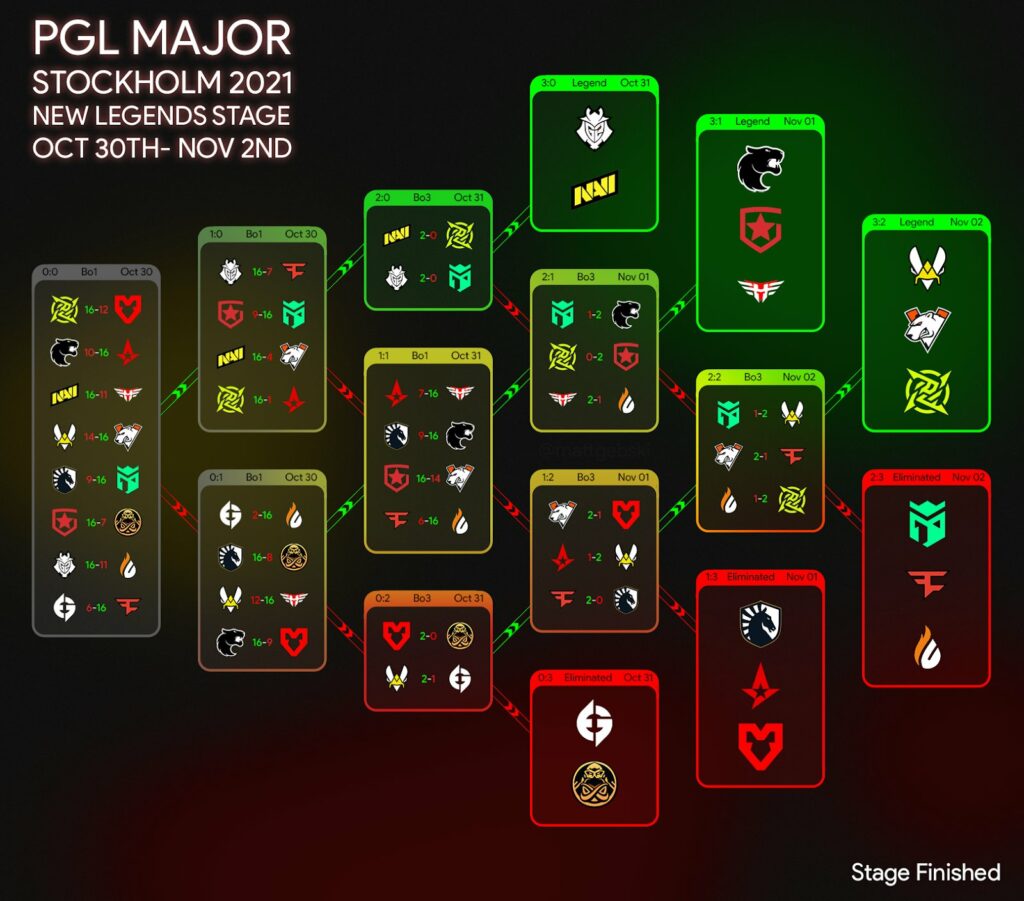
Confused? Let’s look at an example. Suppose we have 16 teams competing in a Swiss-style group stage. In Round 1, all teams are paired based on either a random draw or seeding, resulting in 8 matches. After the round, all teams will have a 1-0 or 0-1 record.
In Round 2, all teams with a 1-0 record would play each other, and those with a 0-1 record would do the same. This continues across multiple rounds until a round limit is reached (usually 5 rounds for 16 teams), with each team always facing opponents with the same score.
Teams that reach the required number of wins will qualify for the Playoff stage, which usually takes the form of single- or double-elimination brackets. The rest are eliminated or may enter a last-chance qualifier, depending on the tournament.
What About Tiebreakers?
A common tie-breaking method in traditional Swiss formats is the Buchholz score, which adds up the win records of your opponents to reflect the strength of schedule. However, this method isn’t really used in esports. Instead, simpler alternatives like round differential or head-to-head results are preferred.
This is especially true for determining playoff seeding, prize money allocation, or filling limited qualification slots. In most other cases, tie-breakers aren’t used at all. Teams rather qualify for the next stage after reaching a certain number of wins, making tie-breakers obsolete.
What Is A GSL-Style Bracket?
The GSL-style (formerly “Global StarCraft II League”) bracket is a dual tournament format. Similar to the Swiss system, it’s used in smaller group stages. What makes it unique, though, is how teams are matched and eliminated.
GSL uses a preset mini double-elimination bracket played over five games. Four teams enter the group and play against each other in two opening matches. The winners then compete for the first qualification spot, while the losers fight for survival.
Finally, a decider match determines who takes the second berth and who gets eliminated. In the end, only two teams advance, while the remaining competitors go home. Still don’t get it? Here’s a quick example to help explain it better:
- Opening Match 1: Player A vs. Player B (2-0)
- Opening Match 2: Player C vs. Player D (2-1)
- Winner’s Match: Player A vs. Player C (2-0) → Player A advances
- Loser’s Match: Player B vs. Player D (1-0)
- Decider Match: Player C vs. Player B (0-1) → Player B advances
History
GSL-style brackets were first introduced in 2010 at the Global StarCraft II League in South Korea. Originally known as the “dual tournament group format,” it quickly became a staple of GSL group stages (hence the name) because of its rapid and balanced structure.
Eventually, it started appearing in other major events, including Dota 2’s The International, LoL’s Mid-Season Invitational, and (you guessed it) the Thunderpick World Championship!
While it was a tad less forgiving than the Swiss system, it still offered a redemption path through the decider match. Plus, the chance for revenge matches added a layer of narrative tension, turning deciders into pretty awesome, emotional showdowns.
How do Swiss Formats work vs. GSL-Style Brackets: Differences at a glances
Swiss and GSL formats offer two very different approaches to tournament structure. Here’s a side-by-side comparison of how they stack up across a few key areas:
| Category | Swiss System | GSL Bracket |
| Structure | Teams play a set number of rounds against opponents with similar records. | 4-team mini double-elimination bracket played over 5 matches. |
| Matches | Varies by participant count (usually 5 rounds for 16 teams). | Always 5 matches per group, following a fixed bracket. |
| Progression | Teams advance after reaching a set number of wins (e.g., 3-0). | Teams advance after winning 2 matches and are eliminated after 2 losses. |
| Redemption | Early losses don’t knock out teams. They can recover over time. | Teams get a second chance via a decider after 1 loss. |
| Tiebreakers | Only used if needed (Buchholz, round differential, head-to-head, etc.). | Not needed. |
| Drawbacks | Harder to follow and weak seeding can skew pairings. | One bad loss can result in elimination, despite a team’s strength. |
Hybrid Approaches And Evolving Uses Of Formats
Although both Swiss and GSL formats bring something unique to the table, some tournament organizers aren’t afraid to bend the rules. In particular, tournament organizers have adopted modified versions of these systems to shake up the competition.
For example, Riot Games used a modified “win-two, out-on-two” Swiss stage at VALORANT Masters Bangkok. Instead of running all five rounds, teams advanced or were eliminated as soon as they hit two wins or losses, making for a much tighter structure!
A similar approach was used at Worlds 2024, except Riot opted for a five-round version and spread out regional matchups using custom seeding and draw rules. Round 1 teams were paired against squads from other regions, but rounds 2-5 were seeded on win-loss records.
Meanwhile, BLAST stuck to a classic Swiss format for the 2025 Austin Major and even used Buchholz scores for ties. While GSL-style brackets have gone largely unchanged, Valve brought some refinement by blending GSL groups with final elimination rounds at The International 2024 qualifiers.
Catch Every Tournament Right Here
Think you’ve got a firm grip on these systems? Then put your knowledge to the test! From tightly matched Swiss stages to intense GSL brackets, you can find both formats live across some of the biggest esports titles at Thunderpick, the world’s premier crypto betting provider.
With unbeatable odds and broad coverage of popular games like Counter-Strike 2 and Dota 2, you’ll be in the thick of it in no time. Just don’t forget to swing by our Promotions page for epic bonuses to supercharge your bets!
Always practice Responsible Gambling and check out our latest promo offers and boosts. T&Cs apply. 18+ to play.