
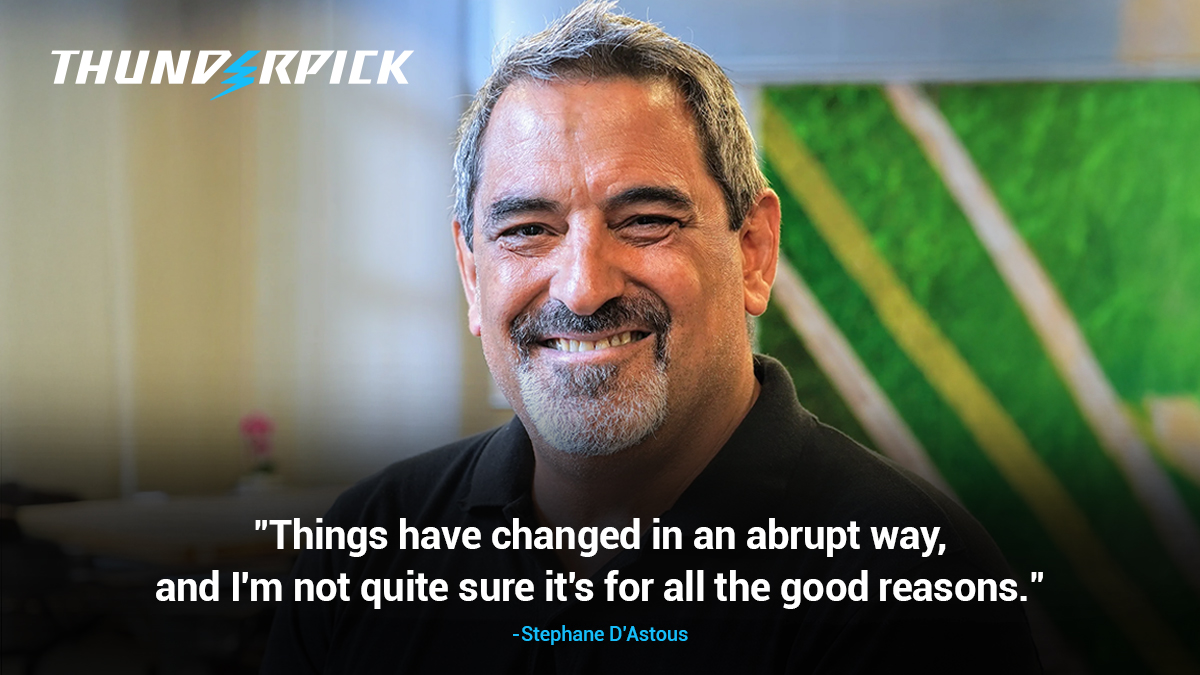
Stephane D’Astous is struggling to recognize the gaming industry he has worked for 20 years.
“The glory days for me were between 2005 and 2015”
The veteran director and operations manager told Thunderpick in an exclusive interview. “Things have changed in an abrupt way, and I’m not quite sure it’s for all the good reasons.” His understanding of the gaming industry matches what Counter-Strike’s creator, Minh “Gooseman” Le, said about how it was much easier to launch a PvP game 10 years ago.
Back then, gigantic companies like Valve and Tencent weren’t as big as they are today, according to D’Astous, and entities like Saudi Arabia’s Public Investment Fund had yet to invest into competitions such as the Esports World Cup as we know it today.
A subtle change
Stephane D’Astous: There’s another major aspect that I think people overlook too much is that there is a great consolidation in the industry. The big players 15 years ago are not necessarily big players. There’s new players. 15 years ago Tencent existed but it wasn’t the 800-pound gorilla it is today. NetEase wasn’t quite there 15 years ago. Now they’re a very big player. If you look at the sovereign fund of Saudi Arabia that has unlimited resources buying up EA, 15 years ago who would have said that EA was on the chopping block to be bought?
Is the bubble popping?
That was also the time when D’Astous was working as Ubisoft Montreal’s director of operations, working on Prince of Persia and Tom Clancy’s Splinter Cell. He founded and built the team behind Deus Ex: Human Revolution at Eidós Montreal in 2007, which became part of Square Enix in 2009.
“The people with the money and the decision power are much fewer, and their pockets are much deeper,” he says. “Plus, they don’t have the same DNA of the decision maker 15 years ago; it’s much more Excel than passion-driven.”
Stephane claims that, besides changes in investment, COVID and AI were the other two elements that damaged the gaming industry. He explains that during COVID, when everyone was at home playing, investors were eager to spend millions on game development while expecting that rise in engagement to be sustained post-lockdown.
“Thousands of projects were given money, green-lighted,” Stephane says. “When I saw some of those … I said, ‘That idea was funded? Oh my god, this is bad news,’ because it will take the bomb to explode at least three, if not four, five years from now. We’ll see the end results of that bad decision of this investment.”
Such timing matches the countless industry layoffs we’ve witnessed since 2023. He believes game executives today have unrealistic ambitions about development.
“How many times have I been asked to do the Witcher 3-like game with a limited budget in less than four years with a new team? This doesn’t coincide with sustainability,” Stephan explains, remembering that the time when he developed the Prince of Persia trilogy at Ubisoft in three years won’t come back.
“The teams were quite small back in 2005-06, and it gave birth to a bigger, ambitious game, which is a logical business creative process to follow,” Stephan explained, recalling the birth of Assassin’s Creed. “Not having the discipline of saying ‘no’ to what we call ‘scope creep.’ Somebody must say if it’s not reasonable, to say no. All this is also to have proper stage-gating, because this will avoid digging the hole deeper if it’s in a bad way.”
The results of game development fully assisted by AI are coming soon
Stephan’s stance on AI is that it’s inevitable, and game developers will have to adapt to it, at least in parts of asset prototyping, coding, QA, and documentation. Even though big games like Call of Duty have already used AI to create less important artwork, we haven’t seen the development of a big game being assisted from start to finish. That’s because of how long AA and AAA development cycles are, he explains.
“That [AI-assisted] game would have started development with full AI three or four years earlier,” Stephan says, also noting that we can expect a strong AI-assisted AA project to release sometime in 2028.
“I’m afraid that AI will suggest a normalized solution and that innovation will normalize its output,” he notes. “It depends on the prompt, I understand all that. But I’m afraid that innovation, creativity in a certain human way, will be lacking. Everything that is related to pure creation, storytelling, music, for me, needs to be done by a human, and should be kept human-produced.”
Is Eidós-Montréal cursed?
Stephane left Eidós-Montréal in 2013, two years after releasing Deus Ex: Human Revolution. The company did well and released more Deus Ex, Tomb Raider, and Marvel games before being acquired by Embracer in 2022, when game production slowed down. In 2024, the studio canceled a Deus Ex game in development and fired several staff members; in March 2026, another round of layoffs took place, and more projects were shelved. I asked Stephane if it almost feels like Eidós-Montréal is cursed after so many failures.
“If there’s no significant changes in the decision-making process and people, yes,” he said. “I founded Eidos Montreal. It was my baby. I left in 2013 and mentioned reasons of leadership, courage, and communication. Without giving the name of the person that I was relating to, that person is still at Eidós, and now Embracer. Was it Einstein who said, ‘Only stupid people hope to have a different outcome when they repeat something’? There you go, that’s a great example.”
He believes that unless something changes in Eidós-Montreal’s management, the company won’t change direction.
“Because of who is in the driver’s seat in London, and Embracer had the great idea to promote him if you look at his title. If they’re cursed? I’m afraid so.”
Stephan wishes Eidós-Montréal was in a better place for his former co-workers, who he says are great people.
“When I cross the street and former employees recognize me, they come to see me. They say: ‘Those days were the best days of my professional career. We hoped that it would go back to that style of management we had internally at the studio.’ And everybody that worked on the first Deus Ex, Human Revolution, it’s unanimous. People said it was the best experience in their career, and they thanked me for it. I say, ‘Don’t thank me; you did it, because it was a great project.’”
Stephan D’Astous would develop a new Deus Ex
When talking about the Deus Ex franchise, Stephane shared how he felt about the cancellation of the new game in 2024.
“I was very disappointed when Lars from Embracer said in 2024 they wouldn’t do any more Deus Ex,” he revealed. “I said, ‘What are they thinking? That was the bread and butter; that’s the DNA of the studio.’”
Stephane would work on a new Deus Ex game if he could. “That would be a perfect circle back to my early career,” he said. “I would definitely be able to gather former employees who worked on it and other people that would love to work on it.”
He believes the franchise would need to stay true to its core mechanics of choice and consequence while expanding on what new technologies allow for today.
“We wanted maybe to add more different multiple endings that are well thought out. I would concentrate on a single-player game, not mobile, as I don’t believe it’s the proper platform for it.”